How Our Pokémon Fan Art Cards Are Made
Four things decide how a card feels in your hand
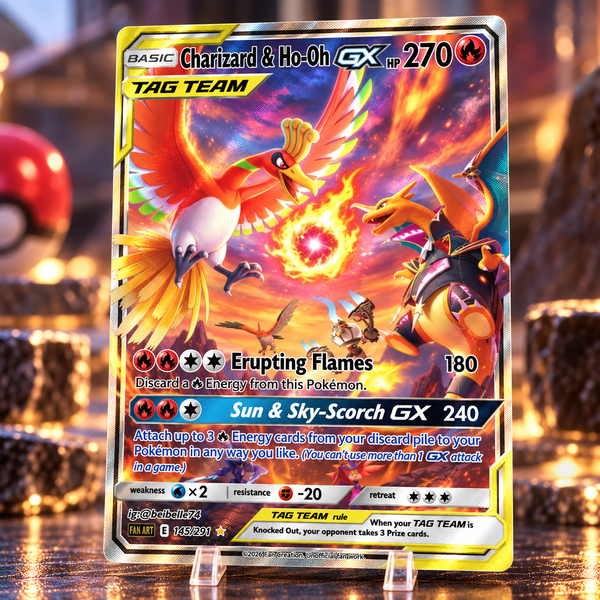
Card stock, foil, coating, and how it is packed. Everything else — the artwork aside — is detail. Here is exactly what we use, and why.
1. Cold-foil press
Cold foil is a metallic layer pressed onto the sheet under pressure, then printed over. The foil sits under the ink, not on top of it, so the artwork keeps its depth while the border catches light. Tilt the card and the border walks through a colour shift; two angles never look the same.
Cheaper cards use a printed "rainbow" gradient that mimics foil. It does not move, because there is no metal in it. If a card's shine looks identical from every angle, it is a print, not a foil.
2. Blue core card stock
Real trading cards are built in three layers, with a blue core in the middle. The core does two jobs: it blocks light so the back print does not show through the front, and it holds the sheet flat.
A single-layer card — the kind printed on photo paper or thick card — curls at the corners within weeks, and a strong light behind it reveals the reverse side. Hold a card up to a lamp: if you can read the back through the front, it is not core stock.
3. Thick UV coating
The coating is what keeps a card looking new. It resists fingerprints, survives a scratch from a sleeve edge, and stops daylight from bleaching the ink. Thick UV also gives the surface a slight bite — you can feel it under a fingernail — which is the same tell collectors use on official cards.
4. Rigid top-loader
Every card leaves here inside a rigid top-loader. Not a soft sleeve, not a paper envelope. Cards that travel flat arrive flat; cards that travel in a soft sleeve arrive with a curl that never entirely comes out.
How that compares
- Vinyl / metal "collector" cards: printed on plastic or metal, sharp edges, no foil layer, and they feel nothing like a trading card. Usually unlicensed art lifted from elsewhere.
- Home printing: photo paper on a desktop printer. Looks fine on a screen, curls, fades, and the back is blank.
- Official cards: the real thing, and priced like it — the point of fan art is that the artwork is new, not that it imitates a card you cannot afford.
What we do not do
We do not reprint sold-out designs. We do not print official card artwork. We do not sell "proxy" cards for play. Every design is drawn by our own artists, printed once in a run of 150, and retired when it sells out.
See it before you buy
Every product page has a short video of the real card being handled, so you can watch the foil move before you spend anything. Start with all cards in stock, or read what a fan art card is.
Fan art, not official product. beibelle74 is an independent studio and is not affiliated with, endorsed by or licensed by Nintendo, Creatures Inc. or The Pokémon Company. All character names are used descriptively to identify the subject of the artwork.